


I am sending you this End-of-the-Year Jackal on January 7, 2026, closer to the beginning of the new year. I have been planning it since November 14, 2025, when it was 73 degrees outside here in Denver and I was wearing shorts. Things eventually cooled off, and by early December we were back in “normal” territory, with 30-40 degree days. Then, the insanity hit: From about December 11th through December 27th, Denver only saw two days where the recorded high dropped below 60 degrees. It was 71 degrees on Christmas. I decided to wait on sending this out to see how long our warm temperatures would go on.
December is usually Denver’s coldest month, beating January by a couple degrees (thanks to some weird wind effects). This December was Denver’s second-warmest on record. I expected January to finally cool things off, but our recorded high on January 4, 2026, was 67 degrees, twenty degrees above the average. It was 55 degrees yesterday and is expected to be the same today.
Something is going on.

This is a picture of my garden on October 15, 2025. Maybe the tomato plants are a little strained, but it was very happily producing fruit. We didn’t fully remove it until October 26th.
If you know me, you know that I love my garden, to the point where the winter months almost make me sad. Being able to give your kids fresh tomatoes and cucumbers every day from July through September really is a gift. But that gift period has gotten a lot bigger over the past few years; the season has now expanded into early May and late October. That means more tomatoes, which are delicious. But it’s all coming at a cost.
When I lived in New York, I fully acknowledged climate change as a reality. As someone who lived through Hurricane Sandy, it was hard not to think about it. But I didn’t become truly aware until moving to Colorado and learning about “wildfire season.” Hot temperatures combined with a dry climate make hiking a challenge. And then there’s the smoke.
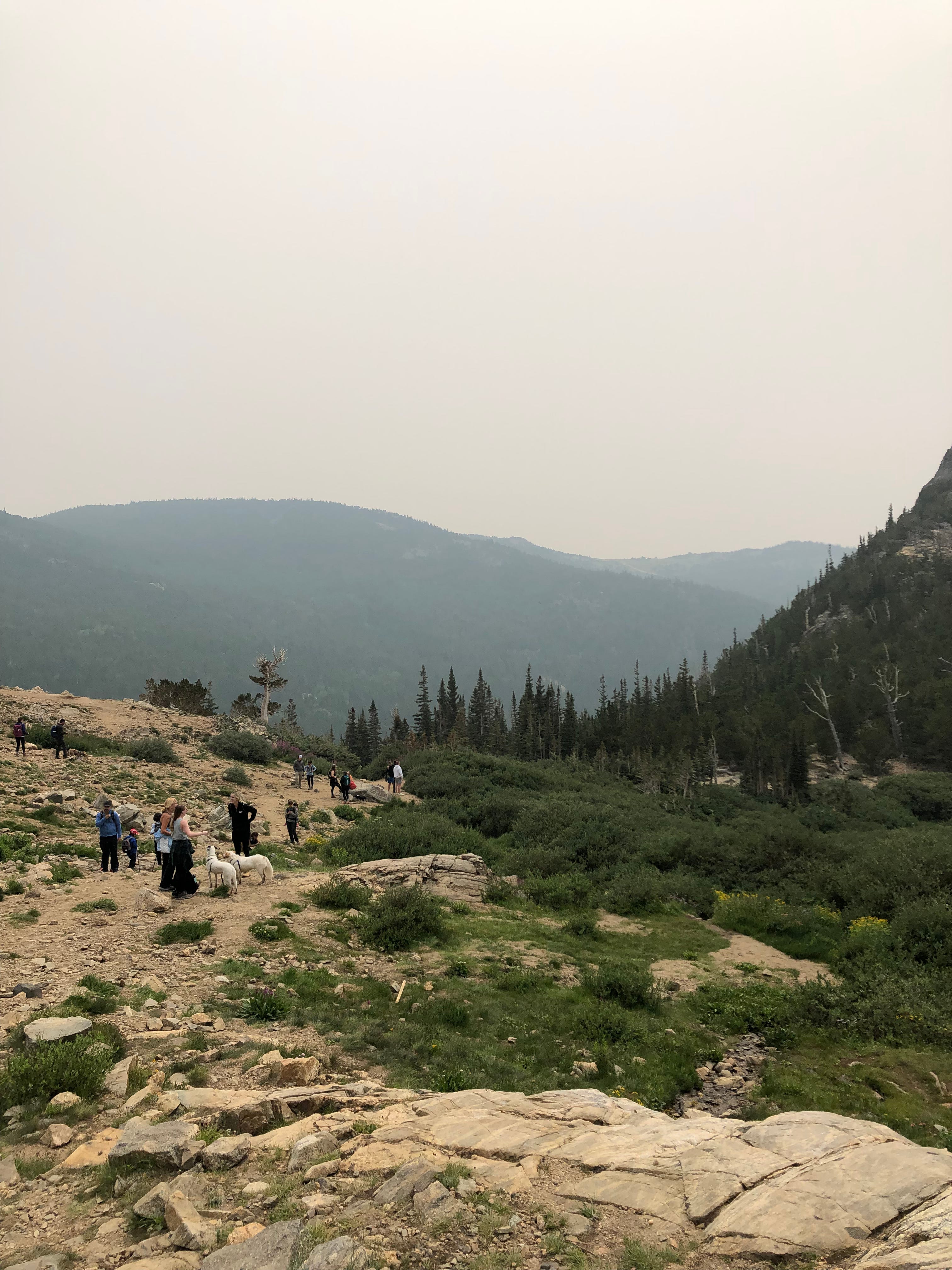
Our first home on the western side of Denver had a beautiful view of the mountains, since it was a townhome with a rooftop deck. It sounded like a great idea, until we realized that choking through wildfire smoke during 100 degree days made it essentially unusable in the middle of the summer.
Now, with two children, I am worried about the world we are leaving them. Sure, there will be more tomatoes, but what else is going to happen?
Climate change is real.
The fundamental problem with our current “debate” about climate change is that only one side mistakenly believes that there is actually a “debate.” The Left acknowledges reality and the Right does not. It wasn’t always like this.
Donald Trump - the current head of the Republican Party - has said that climate change is a hoax invented by the Chinese. Leaders from the Party both in government and in media have fully rejected the idea that the earth is warming at all, let alone that the warming is caused by human activity.
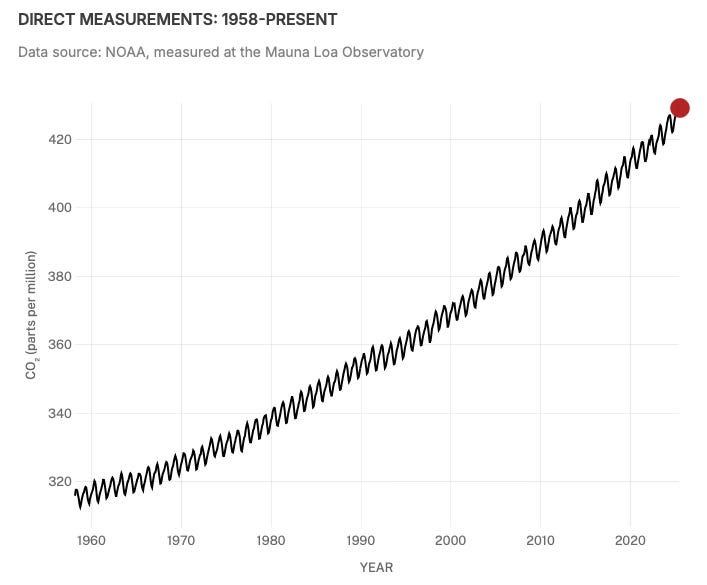
But the science is settled. We can see it by measuring nearly every aspect of the environment in the 19th, 20th, and 21st Centuries. CO2 levels are up:
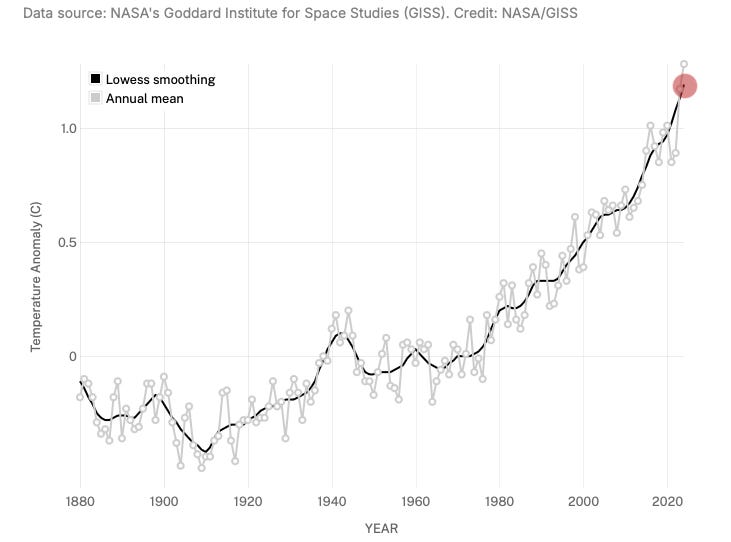
Global earth temperatures are the highest they’ve been in over 100 years:
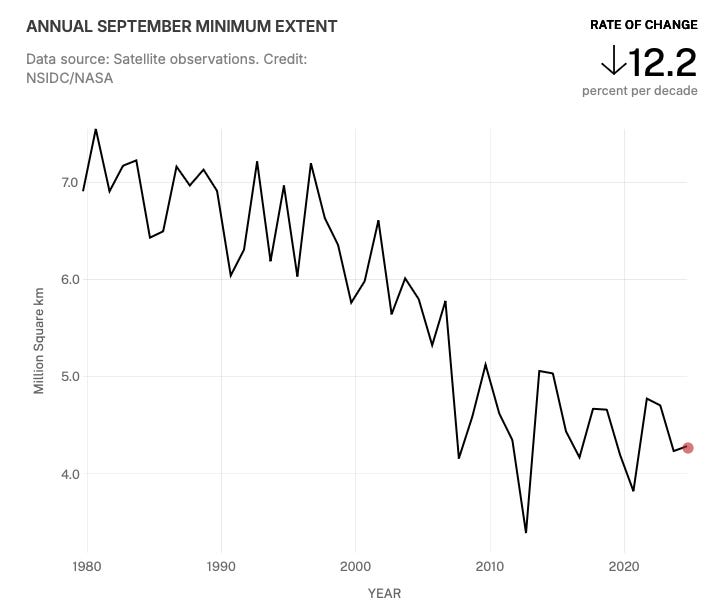
Arctic sea ice is decreasing, on average, by 12.2% each decade:
Sea levels continue to rise, which will displace millions of people across the globe:
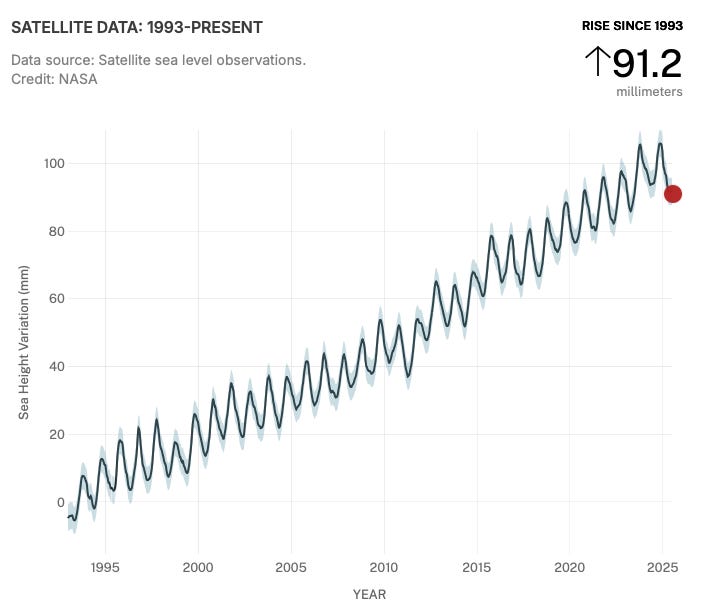
And these are just the recent data. When we look back over longer periods of time, it becomes truly shocking:
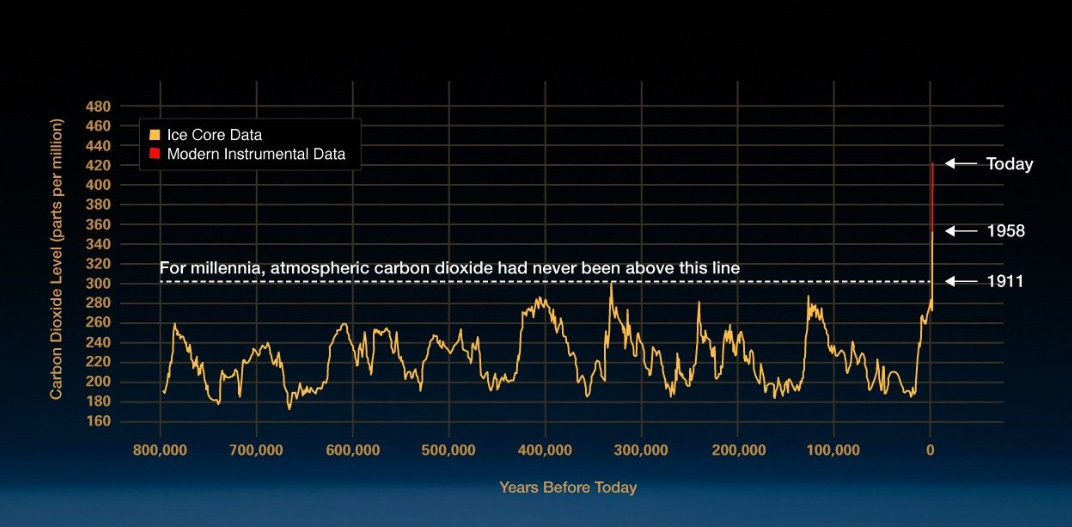
And it’s not surprising what is causing this accelerated warming trend (us):
Carbon dioxide (CO2) is an important greenhouse gas. Greenhouse gases trap the heat from sunlight, warming the planet. Without any greenhouse gases, Earth would be too cold to support life. But the more greenhouse gases there are in the atmosphere, the warmer the planet becomes.
Carbon dioxide comes from sources such as the burning of fossil fuels (such as coal, oil, and natural gas), wildfires, and volcanic eruptions. […] Ground-based and satellite measurements have measured a sharp increase in atmospheric CO2 in recent decades. With a more than 50% increase in CO2 since the start of industrial times in the 18th century, scientific measurements have linked this increase primarily to the burning of coal, oil, and gas. This means that CO2 levels are now 150% the value they were at in 1750 — this is at least 1.5 times greater than the natural increase observed at the end of the last ice age 20,000 years ago, which happened over thousands of years (my emphasis).
Even if, after all this evidence, you do not believe in climate change (or that human activity is to blame), climate change believes in you. In 2025, the first mass migration due to modern climate change happened: An entire country - Tuvalu - began its relocation to Australia, because rising sea levels will eventually erase it from the face of the earth. And more of this is coming.
Christians are called to acknowledge truth.
The direction of the charts above is one thing, but then interpreting them is another. There is universal agreement amongst scientists that humans are responsible for higher global temperatures.
A study first published in 2004 reviewed almost a thousand peer-reviewed articles on climate change and did not find a single one that rejected the idea that it was man-made.
The Doran and Zimmerman study from 2009 similarly found that 97% of scientists agreed that human beings were behind our recent warming.
The Anderegg study in 2010 found the same thing.
The Cook study also found the same thing in 2013.
More recent (and larger) studies have found even more universal agreement. Across 88,000 different scientific studies, 99% agreed that human beings were warming the planet.
I’m sure this is where the climate skeptics will jump in: “David, you are ignoring the 1% of scientists, who are surely right about this and everyone else is biased.” This is an argument I have heard a lot on topics ranging from vaccines to 9/11 being an inside job:1 There are “experts” whose views are being overlooked, because the opposition is paid off or bullied into their beliefs.
But that same argument is never applied within Christianity itself. Jesus’s actual existence is not seriously debated amongst biblical scholars, and that applies to both secular and Christian historians. Even atheist scholars agree that Jesus was a real, historical figure and not a figment of the early church’s imagination. But there isn’t 100% agreement.
A minority of scholars argue that Jesus actually didn’t exist and is instead a mythical figure, à la Hercules or Maui (shout out to Moana). In his “documentary,” Religulous, Bill Maher lays out this theory:
I should say: Almost every frame of Maher’s video is false. To begin with, he confuses Mithra (the Persian god) and Mithras, an ancient Roman cult movement. Mithra has zero similarities to Christ, but Mithras has more than a few. The problem is that Mithras came after Christ, and was imitating Christianity, not the other way around.
Maher’s views are heavily in the minority and unsupported by evidence, and they are not being suppressed or discarded because of Big Antiquity Scholarship™ or a conspiracy held up by corrupt historians. But Christians who deny the man-made, scientific explanations for global warming (and, again, for vaccines and other issues) are no different from the Mahers of the world. Think of it this way:
99% of scientists agree that climate change is being accelerated by humans.
“I’m going to go with the 1% who disagree.”
99% of historians agree that Jesus existed.
“I’m sticking with the 99% because the 1% aren’t credible.”
You cannot use the scientific method to get you to one place and then take an off-ramp when it takes you to a place you don’t like.2 It is true that Jesus existed (and, I believe, died and rose from the dead), and it is true that humans are behind the effects of climate change.
Stewardship is a biblical calling.
Some Christians argue that because God is in control of the weather, then climate change is impossible. We - mere mortals - cannot do anything to alter the planet’s ecology. But this is an irresponsible narrative, in addition to being anti-biblical.
Christians are charged with being stewards of the planet in the book of Genesis, where we are called to “take care” of the earth. Call me crazy, but if we have lots of evidence that burning through rapid amounts of fossil fuels (usually in pursuit of consumerism, which is a another discussion) is damaging the environment, that is neglecting our God-given role as caretakers of the earth.
It is also clear by now that being given stewardship over something suggests that our activity can have an effect on that something. God calls us to be good stewards of our finances. He calls us to be good stewards of our bodies. He calls us to be good stewards of our mind and to avoid things like excessive drinking. I don’t see anyone seriously trying to argue that because God has ultimate dominion over our finances, health, bodies, and sobriety (along with everything else), that we should ignore his directive to be good stewards of those things. If you mishandle your finances, you are a bad steward of what God has given you. If you mishandle God’s good, green earth, you are a bad steward of what God has given you. It logically follows.
I don’t think any book I’ve read in the past 10 years has affected me more than The Ruthless Elimination of Hurry by John Mark Comer. It hit me so hard I forced my whole bible study to read it with me. But in it, Comer lays out the calling of the Christian: A simple, contented life. Some of you may have seen those giant pickup trucks that people purposefully outfit to emit more smoke and pollution, basically giving a big middle finger to the climate change folks. You can call that lots of things, but it is not simple or contented. Comer also talks about how nature can bring us closer to God:
Creation - especially places that are yet untouched by civilization - has the potential to wake us up to our Creator in ways that few things ever can. It invokes gratitude and that secular unicorn, wonder. If materialism despiritualizes us, the material world itself has the opposite effect; it respiritualizes our souls.3
As someone who hikes in Colorado, I can definitely attest to this:
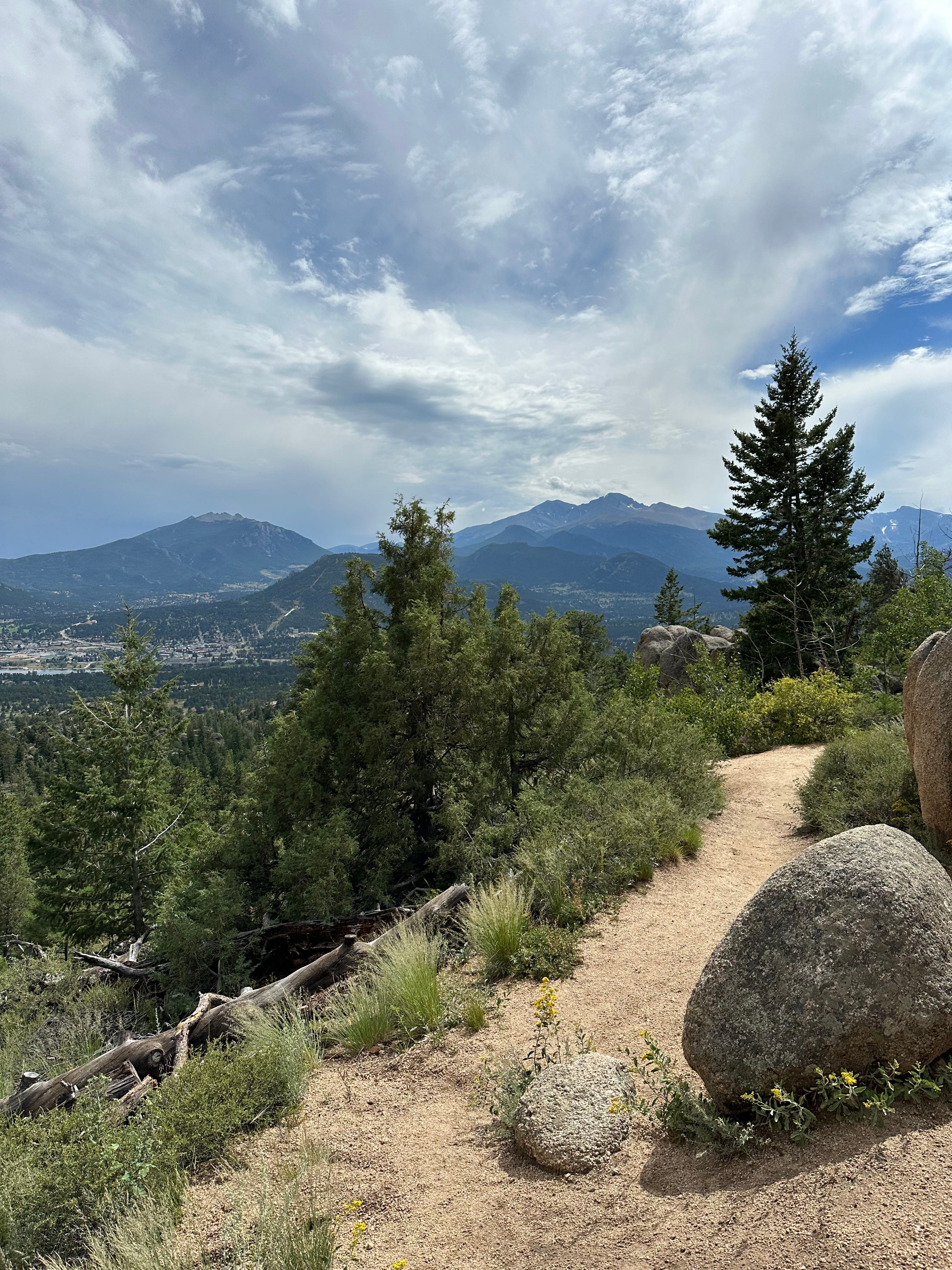
Colorado is filled with endless beauty, pointing us back to our Creator. If we destroy that beauty, are we severing a line to God?
Because our politics are now so heavily infused with religion, I think too many Christians have reflexively assumed that it is God’s intention for us to be pro-climate change, and burn through more gas and coal. But the neat thing about Christianity is that it cuts through any political party’s current beliefs (more on this later). And the Bible’s teachings on contentment (along with Comer’s4) surely current stance on climate change.
What does it look like in practice?
Well, this is a newsletter mostly about acknowledgement. For the deeper answers, I don’t have a really good explainer. Does this mean that all Christians should buy electric cars? I don’t think so, mostly because the infrastructure doesn’t seem to be there yet. My wife and I also use disposable diapers, as opposed to re-usable ones, which are definitely better for the environment. While we do have friends who used re-usable diapers (and they probably love God more than we do), there also has to be a balance for time, stress, and general tiredness, especially with newborns. My point is: There is a lot of room for grace here. One thing Elisabeth and I have tried to be conscious of is where we are buying our clothes from. My toothbrush is made from 100% recycled materials, which is neat. We also use re-usable water bottles, but that is something required of every Coloradan (along with getting a dog). The little things can make a difference if everyone does them.
I think it’s also important to acknowledge that we - the world - have made huge changes and are, in fact, reducing carbon emissions. The U.S. has reduced its net carbon emissions by 17% since 2005, and we have made major headway on the transition to electric, wind, and solar power.
For a long time, there was an argument against these reductions in carbon emissions - or at least the general call for them - because it would do a disservice to developing countries who did not get to experience the benefits of the Industrial Revolution. This argument - put forth by Bjorn Lomberg5 - essentially says that it is unfair for the developed West to reap the benefits of heavy carbon emissions, while demanding the same of less-developed countries in the South and East, who did not contribute as greatly to the current climate problem. But when you look at Asia, especially India and China, they have been able to reduce their emissions by a ton while also growing economically. Because of the economic opportunities associated with solar, wind, and electric energy, India has shown that it is possible to reduce your carbon emissions while also emerging from a “developing country” status. And China expects to be fully carbon neutral by 2060. I think Lomberg’s argument has been proven wrong.
Where he might still have a point is that the private market seems to be doing a pretty good job of pushing itself towards more carbon-neutral solutions. That’s a bigger debate altogether, but with hybrid models - government incentive combined with private enterprise - the U.S. and other Western countries have made great progress. We need to do more.
My position is normal, rational, and conservative.
A thing that I lament is that I have to write this piece at all. I remember being with a conservative friend when John McCain released his plan to address climate change in the GOP’s 2008 Platform. The two of us - both Republicans at the time - were excited to see him (and Sarah Palin!) acknowledge the factual matter and propose a private, free-market solution. Reading it today feels alien. After acknowledging that, “The same human economic activity that has brought freedom and opportunity to billions has also increased the amount of carbon in the atmosphere,” the GOP platform lays out multiple ways to tackle climate change.
It ends its section on climate change with this:
The Republican perspective on the environment is in keeping with our longstanding appreciation for nature and gratitude for the bounty the Almighty has bestowed upon the American people. It was Republican President Theodore Roosevelt who said, "The conservation of natural resources is the fundamental problem. Unless we solve that problem, it will avail us little to solve all others." We agree. Whether through family vacations, hunting or fishing trips, backpacking excursions, or weekend hikes, Americans of all backgrounds share a commitment to protecting the environment and the opportunities it offers. In addition, the public should have access to public lands for recreational activities such as hunting, hiking, and fishing.
In contrast, the 2024 GOP platform mentions climate change zero times, in addition to being almost one-fifth the size of the 2008 platform. After acknowledging the reality of climate change, we should also acknowledge that the Republican Party has changed. Or at least what they say publicly has changed.
Remember all the charts from above? The ones that show accelerated warming and attribute it to humans? They come directly from the current Trump Administration, including the quote about climate change being caused by the burning of fossil fuels. They can say whatever they want to their constituents, but I know how to read. Maybe after they read this Jackal they’ll take those pages down.
It is sad that it now offends people when you say, “Climate change is real.” But one day the political coalitions will change. What will stick around: The Christian obligation to acknowledge truth and practice stewardship.
I really do love my garden. I love picking tomatoes with my eldest daughter, and I love it when she begs for cucumbers as soon as we pluck them from the vine. I am writing this mostly because I am afraid of the world we are giving her. Climate change is going to bring about drastic changes to our planet. There will be mass migration events, water and food shortages, and animal extinction. Still, I am not a fatalist; humans have adapted to changes in climate before and I suspect we will do so again, through pain and suffering.
My garden also connects me to my grandfather, who passed away 15 years ago this year. I am getting older and my memories are fading, but the ones I have of my family going to his house in Queens and eating from his garden are sticking around.
I have known for many years that my grandfather lost his own father when he was just nine years old. His dad, Paul Magliochetti, was trying to break up a fight between two of his neighbors, and one of them shot him. I only recently learned that it happened on Thanksgiving.
For my most of my life I spent Thanksgivings with my grandfather, without even knowing about the pain that day brought him. He died on St. Patrick’s Day. I love Irish people, food, and whiskey, but I have trouble mustering happiness on a day that brings so many people great joy. We are all carrying unseen pain.
Our ultimate goal as parents is to pass on a life to our children that is better than ours. To acknowledge pain, endure it, and hope that there is less of it for our kids. My grandfather did that, but I am worrying about what I am doing for my two daughters, and if simply acknowledging climate change is enough. After all, they will live more directly with the repercussions than I will.
This is where I’m thankful for God’s grace, as we all strive to do better for our kids. I hate that my daughters’ lives may be filled with more pain than mine, and that they will have to make sacrifices that I didn’t. Or maybe we will be diligent enough and serious enough to make the changes necessary to fix this problem. Hope springs eternal. I do know this: Addressing a problem means admitting it exists. Christians have a true obligation to start there.
Our kids deserve to have their gardens, though pain seen and unseen.
The Jackal returns on Friday.
As a reminder, I am currently listed as an “Architect and Engineer for 9/11 Truth,” despite being neither.
There are lots of quick, no-brainer arguments that attempt to “rebut” climate change floating around, but they aren’t serious or have been debunked for years. One is that scientists used to say that the earth was in danger of an ice age before they decided the earth was warming, so we can’t trust them now. That is a myth, mostly invented on the Internet. The climate science has actually been remarkably consistent and shown that human activity is contributing to a warming planet.
Page 211 of Comer’s book.
In Comer’s latest book, Practicing the Way, he reportedly makes the argument I’m making in this post. But I haven’t read it. And no spoilers if you have.
His book, The Skeptical Environmentalist, is a tome but worth reading.