


Hey everyone, we are back for a quick recap of the oral arguments in Trump v. Barbara, the birthright citizenship case. I hope you all had a great Easter and that you enjoyed the Holy Week Jackal. Now we get to talk about how the Trump Administration is going to lose the birthright citizenship case.

Are we seriously doing birthright citizenship again? Didn’t we do this last year?
Yes to both questions: If all of this seems familiar, it’s because there was a separate case involving birthright citizenship in front of SCOTUS last year. However, the cases are a little different, and the differences are important.
Last year, the Supreme Court did consider a case that involved Trump’s Executive Order barring birthright citizenship (which is what’s in front of them now), but the primary focus was on the legality of the nationwide injunction placed on Trump’s Order from a lower court. Although there was some speculation that SCOTUS would touch on the merits of birthright citizenship, they didn’t. Now they are taking a hard look at the merits, and it doesn’t look good for Trump.
I wrote about birthright citizenship twice last year, including one time where I called it a fake debate. Nothing has swayed me since: The 14th Amendment secures citizenship for any person born here, without regard to the legal status (or lack thereof) of their parents. That has been true since the 19th Century, and the scholarship overwhelmingly says so. There is no real counterargument and anyone saying otherwise is arguing in bad faith.
And it sounds like the Supreme Court is going to agree.
Trump is going to lose. We just don’t know by how much.
Listening to the oral arguments, the universal reaction was that the Trump Administration was going to lose this case, with the final lineup being somewhere between 7-2 or 8-1 in favor of striking down Trump’s Order. Here is Steve Vladeck with a good reflection on the case:
If anything was clear during Wednesday’s Supreme Court oral argument in the birthright citizenship case, Trump v. Barbara, it’s that President Trump is going to lose. The justices’ questions were skeptical enough to suggest that somewhere between six and eight of the justices will hold that Mr. Trump’s executive order purporting to limit birthright citizenship is unlawful, whether because it violates an immigration statute Congress enacted in 1940 and updated in 1952, the citizenship clause of the 14th Amendment, or both.
In retrospect, and despite efforts by some right-wing commentators and scholars to muddy the waters, this has always been an open-and-shut case under almost any approach to constitutional and statutory interpretation.
I think it is incredibly important to note that it is an Executive Order that is technically before SCOTUS, and it was rarely - if ever - brought up. Instead, the justices focused almost entirely on (1) the constitutionality of the 14th Amendment as a whole and (2) Wong Kim Ark, an old SCOTUS decision securing birthright citizenship.
Put simply, if SCOTUS had any intentions of upholding Trump’s Executive Order, then they would have talked about it some more. Heck, if they thought the statute enshrining birthright citizenship was wrong, it seems like they would have brought that up too. Instead, they focused almost entirely on its constitutionality under the 14th Amendment. At the very least, Trump’s Order is going bye bye, but I think all the justices (yes, all) are going to want to settle this issue once and for all.
Give me the numbers.
Above, Vladeck says he thinks the decision will come down somewhere between 6-3 or 8-1. Steve is smarter than I am, but when I listened to the oral argument I didn’t clearly hear a single vote for Trump.
I think too many people are assuming Justices Clarence Thomas and Samuel Alito are going to side with the Administration, because they are two of the least swingiest votes on the Court.1 But Thomas’s first question sort of suggested that the Administration was taking the side of the Supreme Court in Dred Scott, which is (generally) not where you want to be.
Likewise, Alito bailed out the attorney who opposed Trump’s Order at one point, and gave her a ladder to climb up (she declined). Alito is the best and most frequent questioner on the Court, so I think lots of people are taking his peppering of questions as an indication that he wants to side with the Administration. I’m not so sure. I could actually see a 9-0 decision here, with Thomas and Alito either writing separate concurrences or joining in one together. It just seems like they both know that - whatever their policy preferences - the scholarship on this issue is overwhelming and they do not want to ruin their reputations within SCOTUS-world by being in the minority.
As for the other conservatives, it seems to me like Amy Coney Barrett is a hard no. She spent a considerable amount of time asking about “foundlings,” which was how people in the 19th Century described orphans. Basically, if you don’t know who the child’s parents are, how do you determine citizenship?
Professor Akhil Amar addressed this in an amicus brief filed before the Court:
By contrast, parentage opens a Pandora’s box, and implicates devilish questions not always defined by uniform federal law operating in other contexts. Who are a baby’s parents? What if a mother is married to one man, but another man is the biological progenitor? What if there are disputes about biological parentage?What if a baby’s biological father is unknown? What about foundlings? In today’s world, what about a baby born from Woman A’s egg and Man B’s sperm, who issues from the womb of Woman C and is also claimed by Humans D, E, and F (A’s, B’s, and C’s respective lawful spouses)?
If Barrett is being influenced by Amar’s briefs, I think it’s safe to say she’s not a getable vote. Neil Gorsuch also seems like a no. He made various statements where he criticized the Administration’s position, and then there was this moment:
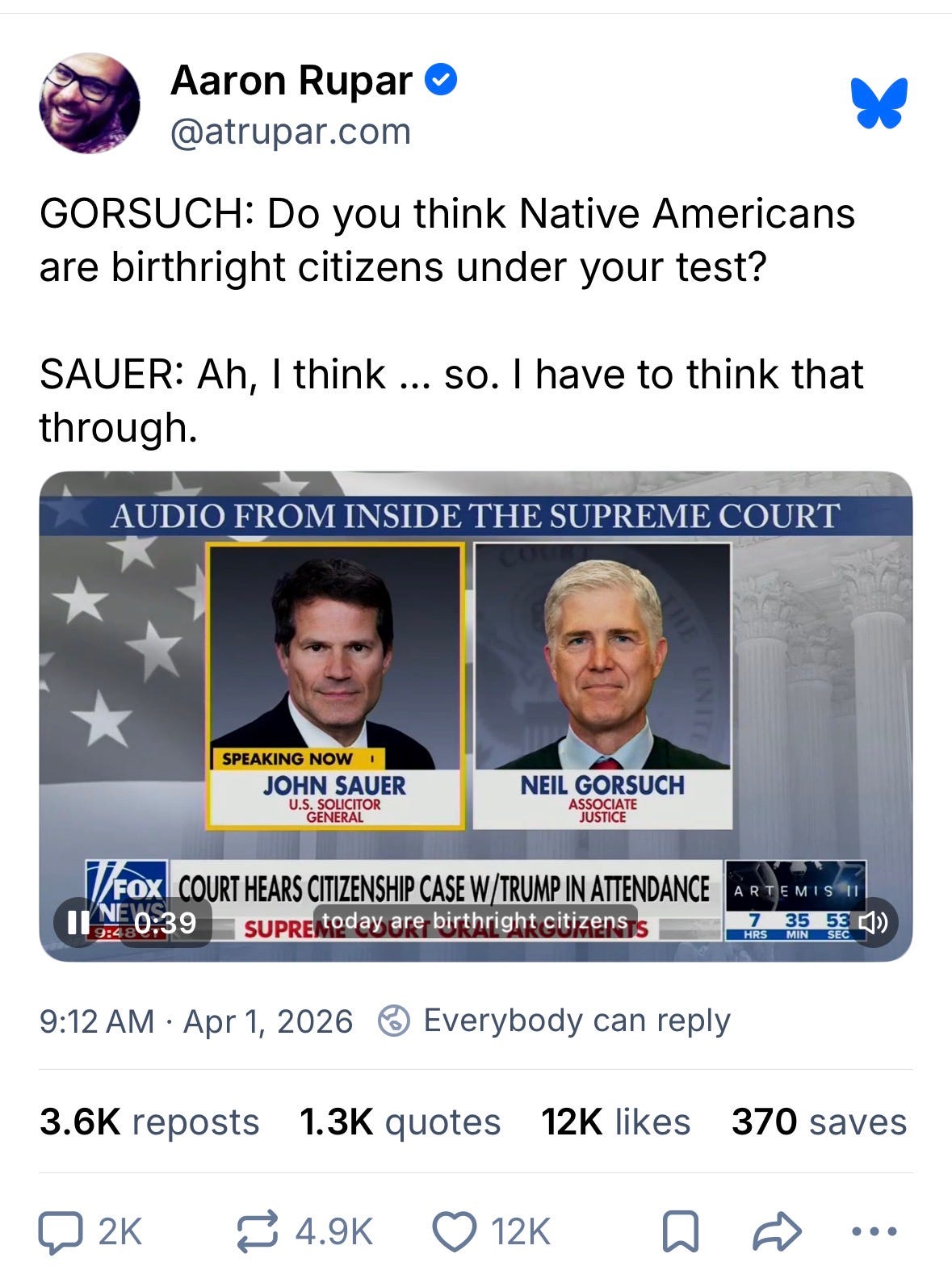
This an insane position to take for a few reasons:
[Solicitor General] John Sauer not being ready to explain to Neil Freaking Gorsuch what happens to Native Americans is…insane.
Gorsuch’s question is relevant. Native Americans were given citizenship via statute that relied on the 14th Amendment’s birthright citizenship clause. Because the Amendment does not extend citizenship to Native Americans, Congress passed a law including them in the citizenship guarantee. If SCOTUS upholds the Trump Administration’s argument and finds that the 14th Amendment never granted birthright citizenship, then obviously the Native Americans all lose their citizenship.
Speaking of Sauer, there were some pretty big complaints about him at oral argument. Specifically, Evan Burnick pointed out that Sauer completely mis-cited a law review article that he said supported his position. In fact, it was the opposite:
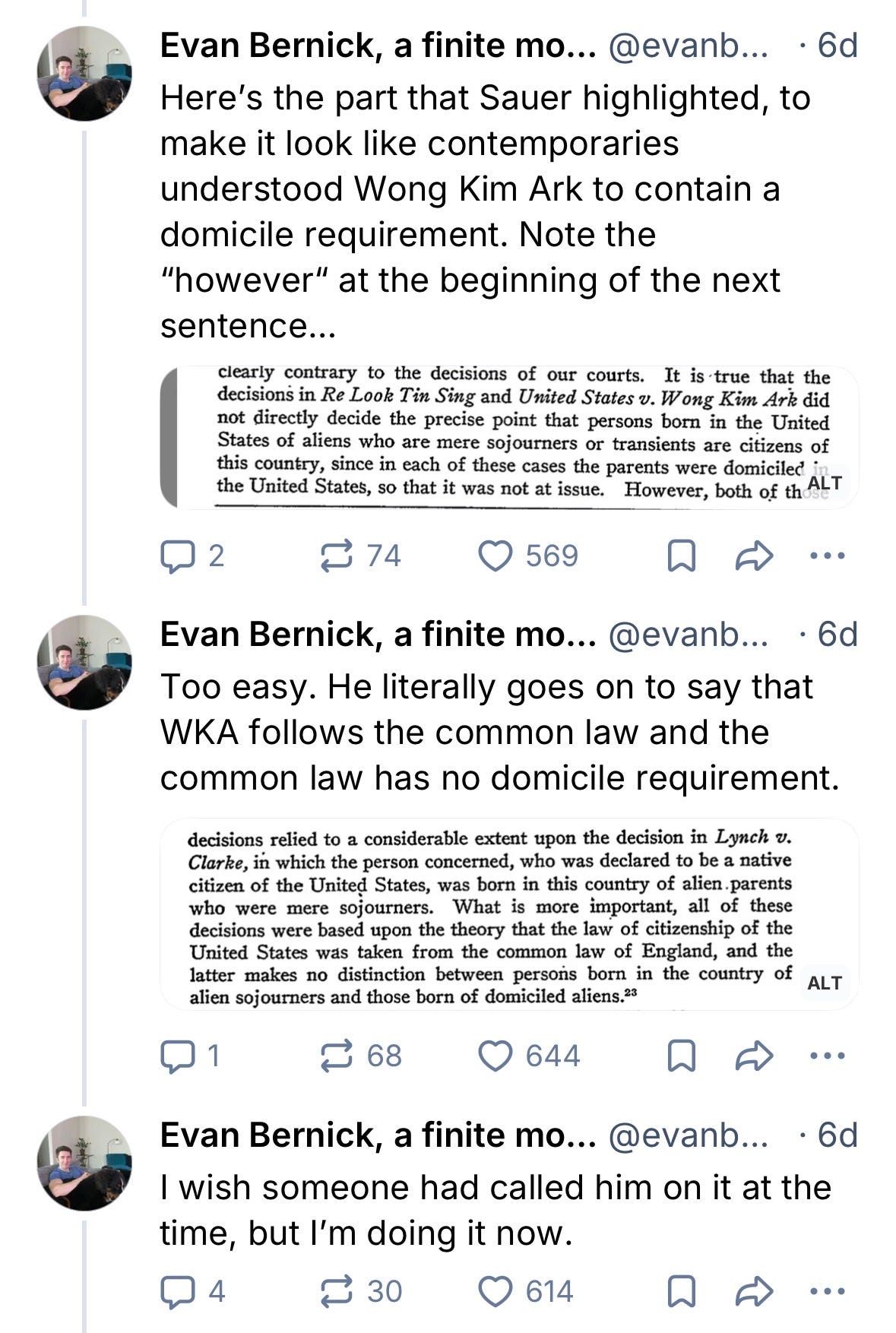
This ended up getting a write-up in the New York Times. Spoiler: It is not a good idea to get something wrong like this in front of the Supreme Court. A lot of people think Sauer was being deceptive and should be punished, but I really don’t think that’s the case (I make no judgment on punishment). I think the reason Sauer forgot to research what happens to Native Americans if he wins; why he got a case cite completely wrong; and why he generally did such a poor job at argument (where he is usually brilliant) is because he didn’t prepare. And he didn’t prepare because he knew going in that he was going to lose. He is a smart guy and he relied (mostly) on the anti-14th Amendment side to do the work for him, so he could do his job and then go home.
As I said above, the anti-14th Amendment people are not writing in good faith, and one of them tricked Sauer with the brief. Vladeck has another good piece on how the pro-Trump side was able to get their (fake) arguments in front of the justices:
The Scottish writer Andrew Lang is usually identified as the source of one of my favorite quotes. Specifically, Lang once complained about economists using statistics “as a drunken man use lampposts—for support, rather than illumination.”
That line has been on my mind as I’ve been watching, mostly from the sidelines, a pitched battle within the legal academy over the fairly transparent efforts of a small cohort of right-wing law professors to provide a fig leaf of historical support for the Trump administration’s legally and morally odious position in the birthright citizenship case. Starting with a tweet and a New York Times op-ed last February insisting that there was already “an entire literature” supporting the government’s position, these folks have spent much of the last 14 months working hard to create the very literature they claimed already existed.
The whole thing is worth a read, but just take note of where this entire approach got the pro-Trump crowd: Having the solicitor general cite to a law review article that contradicted his own point.
Trump is going to lose this case, bigly. It’s just a matter of by how much.
Should-Reads:
We haven’t done this in a while, mostly because I feel bad giving you homework. But I read a really good piece by Elizabeth Bruenig this week on the growing scientific evidence for God’s existence that was a lot of fun.
Three Jackals within one week? That’s crazy. I know the insane person running the country is looking like he could nuke Iran tonight, so if that happens I’ll be back (or maybe we’ll all be dead).
But we have family coming into town and will be busy outside of regular work hours. So it’s touch and go for the moment, with the emphasis on go(ing to drink a thousand beers).
Interesting fact: The swingiest vote on the Court is Brett Kavanaugh. He’s in the majority almost always.