


Guys, the great birthright citizenship saga of 2025-2026 is finally over. I have done a ton of writing on it over the past year and did some work for the amici1 in this case. It feels good to see the decision finally come down. In this Jackal, I’ll break down the decision itself, the reactions to it from both sides, and I’ll have a little note about that Sam Alito “news” we got.
If you want a refresher on birthright citizenship, here is my main piece that I wrote last year. It might be worth reading again, but I’ll make this one easy-to-digest without bogging you down in English Common Law and legal history.
Start my intro music. We’re about to do a general overview, but I’ll also give you some additional reading if you want to go deeper (and some podcasts to listen to if you are tired of reading).

It’s insane that it was this close!
OK, off the bat, I want to address some of the headlines about the case. On the central issue that most people were concerned about - whether or not the children of illegal immigrants get birthright citizenship - the decision was not close. Five justices said that they do, full stop. Then, Brett Kavanaugh said that they do, but Congress could modify that by changing the law (more on that later). Then, Clarence Thomas and Neil Gorsuch both hinted that the children of most illegal immigrants have been here long enough to get birthright citizenship. Gorsuch himself nearly says as much explicitly. Samuel Alito isn’t 100% clear either way, but suggests that Congress could modify the law and also says that we should be “humane” when considering ending birthright citizenship for certain people groups.
On the central question that people were worried about, the decision was really 8.5 to 0.5, with Alito being the only one halfway saying he wants to end birthright citizenship for illegal immigrants. I’ll break all of this down below, but first I want everyone to exhale: It was not a close decision on this issue, and most of the predictions were right.
Well, why are there any dissents at all then?
Great question! (That I have obviously asked myself!) I think it helps to go back to what was actually before the Court:
The question presented is whether the Executive Order complies on its face with the Citizenship Clause and with 8 U.S.C. 1401(a), which codifies that Clause.
That is literally what the Administration presented to SCOTUS: Does the Executive Order survive a “facial challenge.” Facial challenges are hard for opponents (the pro-birthright citizenship side here) to win, because the government usually gets lots of leeway in how Executive Orders are applied. And just because an Order survives a facial challenge doesn’t mean that all aspects of it can be applied lawfully.
Gorsuch and Thomas say this almost explicitly. In their dissent (written by Thomas), they focus heavily on the Order surviving a facial challenge and applying mostly to “birth tourists,” i.e., people who fly here to have children and then fly back to their countries of origin.
Alito says something similar, but his dissent is pretty poorly written and at times doesn’t make sense. Kavanaugh says the Order doesn’t survive a facial challenge because it violates 8 USC 1401(a), so he ultimately answers the question the same way the majority does.
I’m laying all this out because some of the reactions to the dissents were a little hysterical. It is not surprising to me that Thomas and Gorsuch focused on literally answering the question that was before them because they are the two most literal justices on the Supreme Court. Here is an example:
In college, I took classes with the famous Catholic apologist Peter Kreeft. During one of the breaks in class, I saw Dr. Kreeft walking around the cafeteria eating McDonald’s. It was an insane moment: This storied intellectual was eating a meal from my favorite, lowly fast-food chain (it’s still my favorite; fight me). I needed to document this event, so I went up to Dr. Kreeft and asked, “Can I take a picture of you eating McDonald’s?”
After I asked, he smiled and popped the last bit of his sandwich into his mouth and said, “No.” You might say he was being rude, but he was actually just being literal: The way I asked the question referred to ability (“can”) and not permission (“may”). Thomas and Gorsuch - for better or worse - are literally trying to answer the question presented to them by the Administration: Does every application of this Order violate the Constitution or the statute? They say no, and Alito agrees.
OK, then walk me through what everyone actually says.
To give a summary: John Roberts writes for the majority, with Ketanji Brown-Jackson writing a concurring opinion, and both are great. Roberts’s writing goes through the history of birthright citizenship in the United States, and KBJ’s provides even more history and background. I’ll get to them later, because when I read through a SCOTUS decision, I usually start with the dissents2 and then work my way backwards.
I read the dissents first because I like to hear their arguments and then see if those arguments are addressed or rebutted by the majority, and I have to say here, there is a huge quality gap between the dissents and the majority opinion(s): Neither Thomas nor Alito can really contest Roberts or KBJ’s arguments and ignore a lot of what the majority says simply because they don’t have a response.
Thomas’s dissent goes deep into the history of “domicile” and how it was perceived to be a requirement in order to gain either citizenship or be considered a subject (the latter is more applicable during the time period he’s talking about).3 He spends a considerable amount of time going into the pre-American history of domicile and the legal commentary surrounding it, and then cites to a few examples from American history. Basically, to be “domiciled” in America means you intended to stay here and raise your children here.
Thomas is agnostic on the issue as to whether or not illegal immigrants are domiciled here, but the whole of his opinion heavily suggests that they are, so if Trump’s Executive Order were to stand it’s not even clear he’d be OK with barring their children from birthright citizenship. Gorsuch says as much almost explicitly:
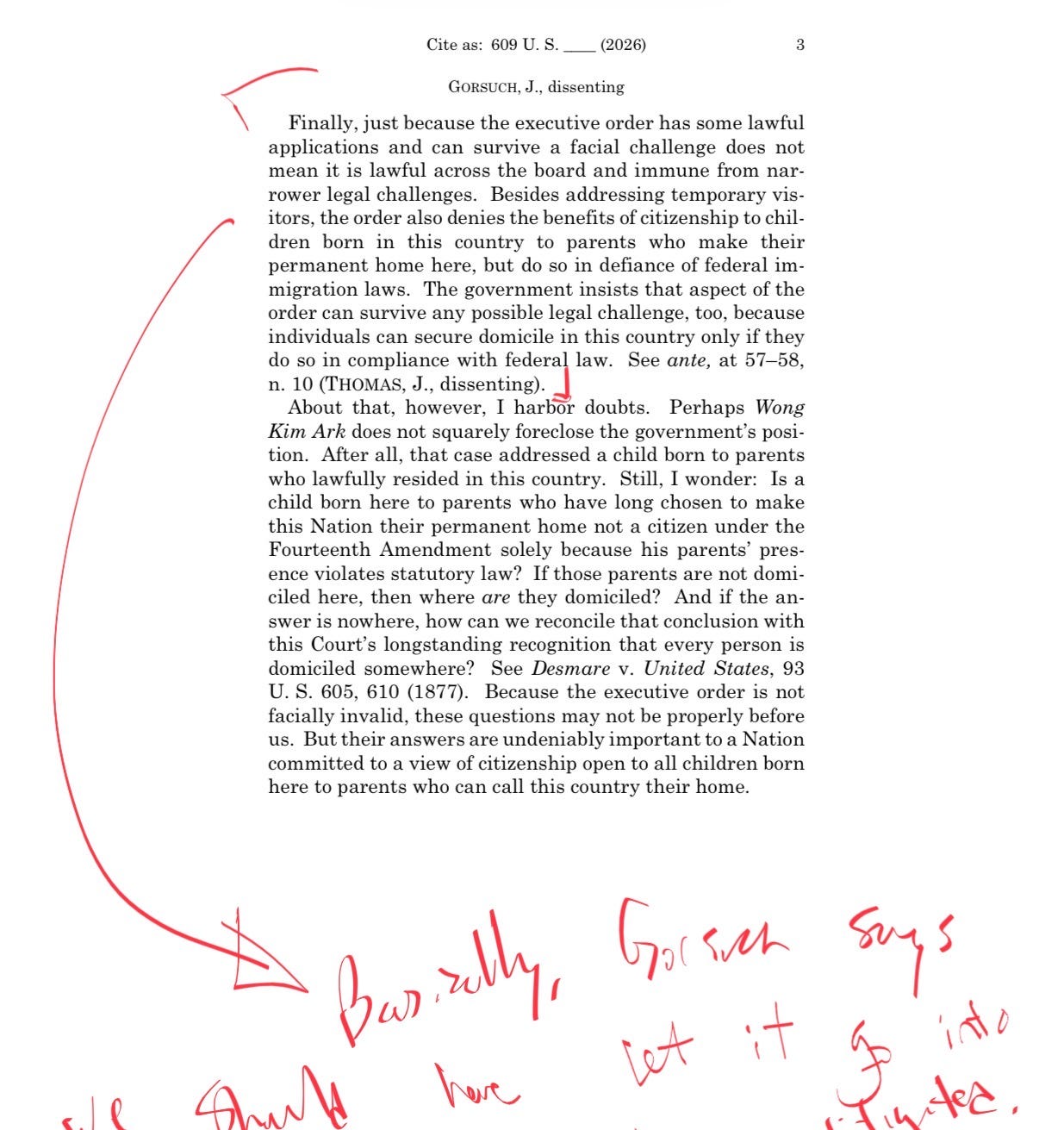
The Administration says, “We can use this Order to deny birthright citizenship to the children of illegal immigrants,” and Gorsuch says point-blank, “About that…I harbor doubts,” and he says this after signing onto Thomas’s opinion. Basically, the two of them are heavily focused on “birth tourism,” which they both seem to assume is an ongoing and serious issue within the United States.
If you look at a lot of the amicus briefs in the case, they are heavily focused on this narrow point. And Solicitor General Jonathan Sauer made it a central point during oral argument, likely because he saw it as the most defensible part of the Executive Order. It’s an interesting thing to focus on, because on its face it sounds problematic: Imagine, for a second, that a Chinese national working for the Chinese Communist Party flies to Saipan in the North Mariana Islands - a U.S. territory - and gives birth to a child, and then flies back to China. That child then immediately gets U.S. citizenship, which sounds crazy! This does happen, but the overall number is pretty small at around 26,000 children a year, which constitutes about 0.7% of all U.S. births.4
Maybe it’s a good thing to focus on and rein in, but I don’t want to be naïve: This reasonable point is really just a way for the Administration to get their foot in the door, and when it’s fully open they want to deny birthright citizenship to anyone whose parents are not citizens. And I suspect a couple of the dissenting justices - without regard to the points they make in this case - could potentially agree to leave that door open.
But for all the history Thomas goes into and how narrow his point is, there is a central problem with his opinion: When he is asked to prove that “domicile” was a requirement for citizenship prior to the 14th Amendment, he can’t do it. Roberts points this out, and does so by arguing that Thomas (and Alito) are essentially ignoring the Court’s previous ruling on birthright citizenship, Wong Kim Ark:
As we have already explained, the Court exhaustively canvassed the text and history of the Citizenship Clause. It traced an unbroken line from the English common law, into the founding and antebellum eras, and through the debates, to the Clause’s ratification. Yet at no point did the Court identify any evidence in the historical record that the ratifiers of the Fourteenth Amendment thought themselves to be imposing a domicile limitation. In the end, it is the dissent in Wong Kim Ark that makes the strongest case for a domicile based theory of American citizenship. There, Chief Justice Fuller resisted the application of the English common law rule because it “recognized no exception in the instance of birth during the mere temporary or accidental sojourn of the parents.” 169 U. S., at 718. He admitted that, in England, “the question of domicil[e] is entirely distinct from that of allegiance” because “[t]he one relates to the civil, and the other to the political, status.” Ibid. But he believed that “a different view as to the effect of permanent abode on nationality ha[d] been expressed in this country.” Ibid. Under this different view, the Fourteenth Amendment “prevent[ed] the acquisition of citizenship by” “the children of aliens, whose parents owed local and temporary allegiance merely, remaining subject to a foreign power.” Id., at 721. The Government and today’s dissenters agree. But this view commanded only a dissent in 1898, and neither time nor circumstance has changed the fact that it is not the law.
Basically, if birthright citizenship had not always been the understanding of American law, the dissenters in Wong Kim Ark wouldn’t have had to write that they were opposed to it. Thomas offers no rebuttal to this at all and his entire case for domicile boils down to five instances between the 14th Amendment’s ratification and Wong Kim Ark, where children were born in the U.S. but not considered citizens.
The problem with these examples is that Thomas largely outsources his reasoning to sloppy arguments from dubious legal scholars, who are writing mostly to get cited by him in a SCOTUS decision. I’ll go through two examples to show how shoddy his reasoning is:
He cites to Mary Deveraux, an Irish woman who arrived in New York by boat and was awaiting immigration processing. Because she was in labor, she was removed from the boat and gave birth in the hospital the next day. She was then placed back on the boat, and was returned to Ireland, with her immigration application denied. Her child, likewise, was not deemed a citizen by the Treasury Department.
It’s debatable whether or not this was even correctly applied, but it (1) happened before Wong Kim Ark, and (2) is an example where the mother was here for about five whole minutes before she had to return home. Her child never even set foot on American soil!
He cites to Joseph Speck, which is described in a letter from Acting Secretary of State Frederick Seward to Hamilton Fish in 1878 (again, pre-Wong Kim Ark). Seward says to “deny citizenship” to Speck because “his domicil, according to the well-understood principles of international and municipal law, follows that of the father until the boy attains his majority.”
This one is egregiously bad, because Thomas misrepresents the letter from Seward to Fish. Here is what Thomas says:
”Joseph Speck was denied citizenship after being born in the United States to parents domiciled in Switzerland. In 1878, Speck claimed to be a citizen after his father returned with him to Switzerland. President Hayes’s Acting Secretary of State Frederick Seward rejected his claim. Although Speck may have been able to claim citizenship had he been domiciled in the United States, Seward denied his claim because “his status, as well as his domicil, according to the well-understood principles of international and municipal law, follows that of the father until the boy attains his majority.”Seward doesn’t say this at all. He says that, for now, Speck can be denied a passport, because he was removed as a minor by his father back to Switzerland. He then says Speck can return to the United States and apply for a passport, but nowhere does he ever explicitly say Speck is not a citizen. Read Seward’s letter for yourself:
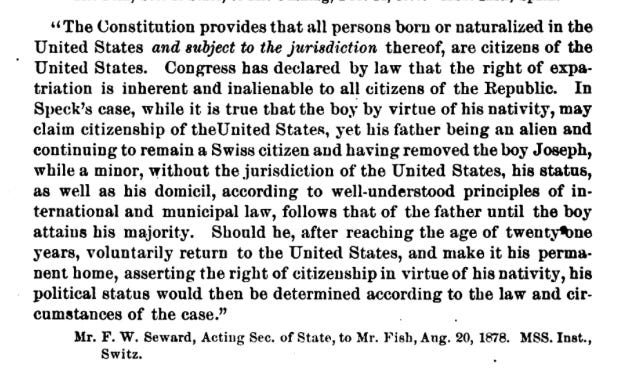
What Thomas is ultimately citing to is letters between Administration officials in the State Department trying to weed through obscure cases where they have difficult decisions to make. They are random, irregular situations where the State Department is trying to figure out what to do. The previous example in these documents is literally a year earlier, and the next case before that is four years earlier. This is not settled policy at all. In addition, in a lot of these cases, they are dealing with foreign governments who want to claim these people as their own citizens and subjects. So, they are somewhat hesitant to claim every single one of these cases on the margins, and in the majority of these cases, they do! Here is a statement from the very same document Thomas is citing to:
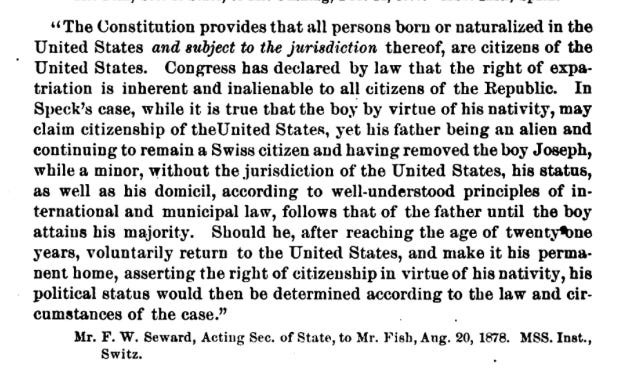

It couldn’t be any clearer. I appreciate that Thomas has tried to make a small case for a carveout on birthright citizenship, but his arguments do not hold up at all.
What about the other two?
Alito’s dissent really doesn’t make any sense. He says the phrase, “…subject to the jurisdiction thereof,” was really about allegiances, and you cannot be allied to a foreign power while acquiring U.S. citizenship.
Alito’s reasoning would completely end dual citizenship, which he doesn’t really seem to contemplate. He also has to completely ignore Wong Kim Ark, because Ark’s5 parents were subjects of the Chinese emperor. Whoopsie! Still, Alito says this:
As interpreted by the Court today, the Fourteenth Amendment confers citizenship on virtually everyone who happens to be born in this country, including the children of “birth tourists,” women who come here solely for the purpose of giving birth to a child and then promptly return home. Careful analysis of the text of the Fourteenth Amendment and the process that led to its adoption shows that it does not degrade the concept of United States citizenship in this way. Instead, the Fourteenth Amendment confers citizenship on only those children who, at birth, owe allegiance solely to this country. Respecting this interpretation would not require uprooting the millions of children who were born here to mothers who entered or remained in this country illegally. […] Some members of this group have lived here for years, and they have a strong moral claim to be able to remain in the land where they grew up. Congress can and should address their situation (my emphasis).
Again, Alito seems focused on birth tourism and uses language that suggests he may allow for exemptions for the children of illegal immigrants. Still, his “allegiance” rationale makes no sense and no one else signed onto it.
Kavanaugh’s concurrence (in part) is the weakest in the entire decision. He completely ignores history and incomprehensibly makes a case for living constitutionalism. Here it is:
To spell that out: The Constitution is an enduring document, and its principles were designed to, and do, apply to modern conditions and developments. The original constitutional principles do not change absent a constitutional amendment, but the relevant principles—both the rules and exceptions alike—must be faithfully applied not only to circumstances as they existed in 1787, 1791, and 1868, for example, but also to modern situations that were unknown or unanticipated by the Constitution’s Framers.
To quote John Roberts from oral argument: “It’s a new world, but it’s the same Constitution.”
Kavanaugh’s opinion is mostly bad because he (along with the others) completely ignore KBJ’s points, which are irrefutable. Her history about the “Black Conventions” is really interesting, but she very effectively rebuts every single dissenting opinion with one point.
The Citizenship Clause of the 14th Amendment was passed as essentially a ratification of the Civil Rights Act of 1866, which was originally passed by Congress. That law eventually landed on the desk of then-President Andrew Johnson, who was on the Union’s side but did not agree that Black Americans deserved citizenship or voting rights. With this history as a backdrop, KBJ makes this point:
When asked whether native-born Romani children would be birth-right citizens of the United States under the proposed Civil Rights Act, Senator Trumbull replied: “Undoubtedly.”President Andrew Johnson apparently agreed. In his message vetoing the Act, Johnson noted with disapproval that, under the law, “the Chinese of the Pacific States, Indians subject to taxation, the people called gypsies, as well as the entire race designated as blacks,” would be birthright citizens. Without making any changes to the bill or responding that Johnson was mistaken in his understanding of it (or otherwise capitulating to Johnson’s views in any respect), Congress overrode that presidential veto.
There is no rebuttal to this in any of the dissents and it’s an incredibly salient point: Andrew Johnson explicitly said, “Hey this law grants all these people citizenship and that’s bad.” Not a single person from Congress said, “Oh, well you know domicile is important,” or, “Oh no, not to non-citizens.” Instead, they overrode his veto and enacted the law.
With a single example, KBJ shows why all the credible legal scholarship in the country is so one-sided on this issue. I also have to say, it is rare for me to see Thomas get completely bested by another justice (conservative or liberal), because he is probably the strongest writer on the Court (closely followed by Elena Kagan). But he gets bested here and it’s not close. KBJ and Gorsuch are both making names for themselves with their writing styles, and it is a lot of fun to see.
OK, reactions.
Before I get into the really unhinged reactions from the Right, I have to start with my homies on the Left. When the decision was initially announced as a 6-3, liberals were apoplectic. They said it was insane that there were even 3 votes to uphold Trump’s Order (as I said above, a facial challenge is different from a full endorsement). Then when they reasoned it was really 5-4, with Kavanaugh siding with the dissenters, they really exploded and said this is why we need to add more justices to the Supreme Court.
Packing the Court must go really hard if you have Cheerios for brain cells, but to reflexively say that before you’ve even read the decision is particularly bad, and it makes me think you really just want to pack the Court to get the policy outcomes you want (I’m right). There is a thing about SCOTUS coverage that I think a lot of people miss: There are probably thousands of reporters covering Congress in the U.S., and then maybe even tens of thousands covering things like financial markets, local stories, or politics in general. For SCOTUS, I think the number tops out at around 35, so it is an especially small group of reporters and most of them lean heavily to the left. I think it skews the immediate reactions to these cases, which then filters down into the supplemental coverage. I disagree with the dissenting opinions, but almost all of them were focused on the narrow issue of birth tourism and not the children of illegal immigrants or birthright citizenship in general. In short, be better.
That said, the reaction from the Right was infinitely worse. I expected them to get a little upset and then move on, but it has actually become a full-blown meltdown. Here was one reaction that really captured it:
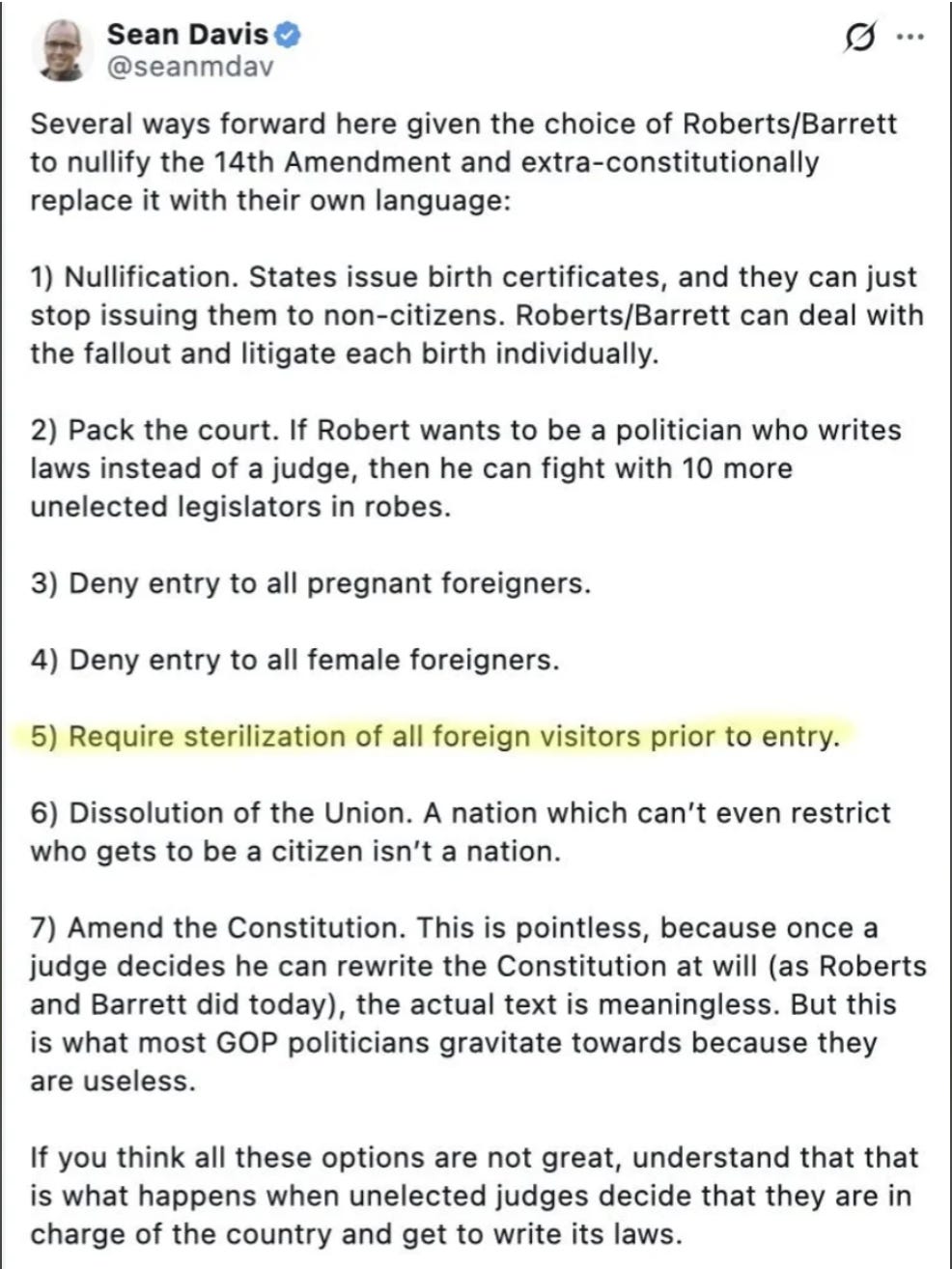
Men are too emotional to be on Twitter.
This whole tweet from Davis6 is actually real. How do you know you’re having a normal one? When one of your reactions to a SCOTUS ruling you disagree with is to dissolve the Union.
He was far from the only one. Matt Walsh has been going nuts for days. Ben Shapiro is very angry. Benny Johnson says this is the end of the Republic. Other conservatives are suggesting “nullification,” you know that thing the South floated when Abraham Lincoln got elected and looked poised to end slavery.
It just shows you that the GOP is now fully Trump’s party. It is a nativist party that hates immigrants, and that isn’t going to change any time soon. I also suspect that the large swaths of the Conservative Media Industrial Complex™️ wants to make this their new Roe v. Wade, and use it to rally support and drive turnout for years to come.
Some of these people are playing that game for show. Here was Ted Cruz’s reaction:
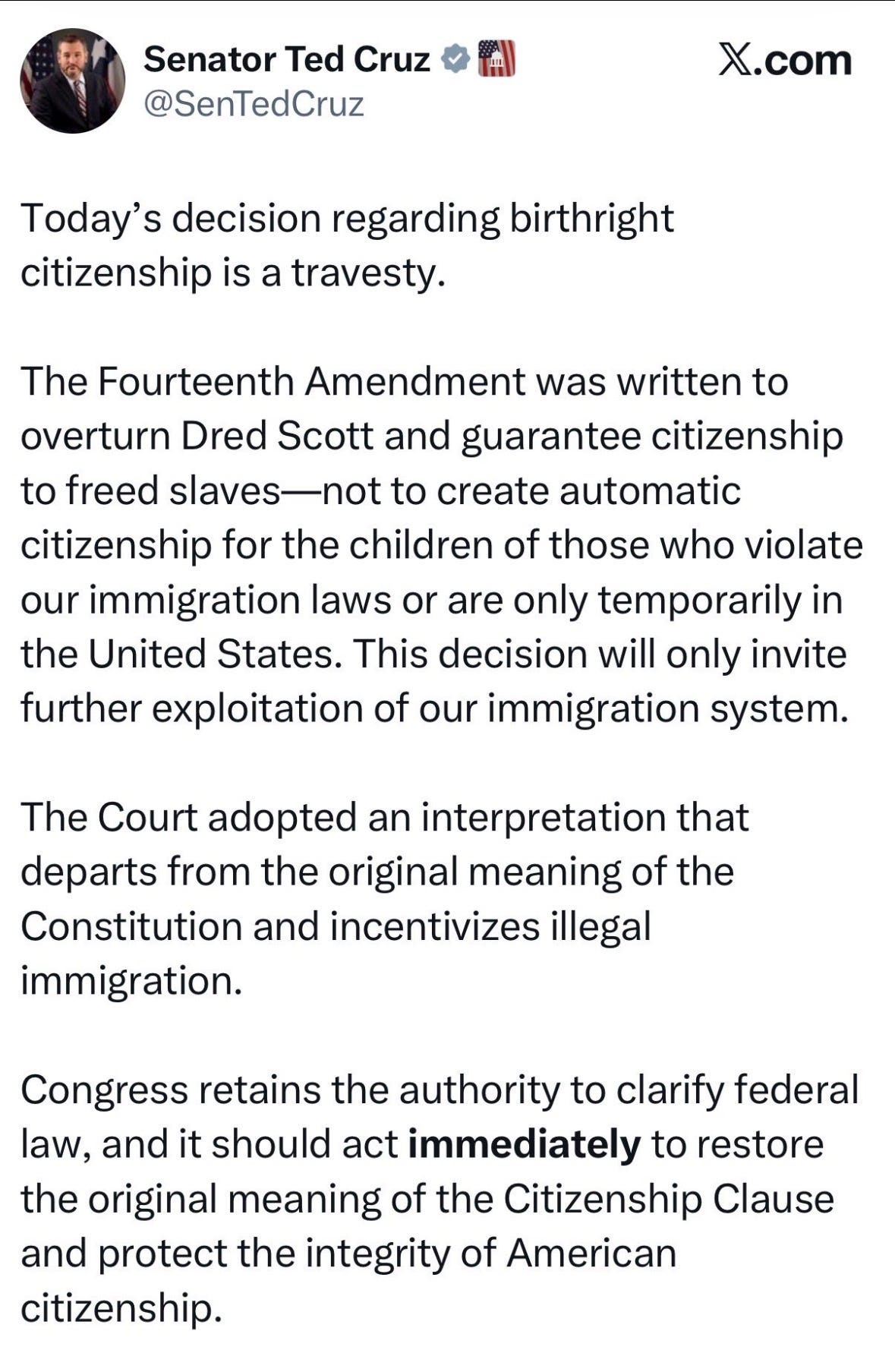
But here was Cruz in 2011:
The 14th Amendment provides for birthright citizenship. I’ve looked at the legal arguments against it, and I will tell you, as a Supreme Court litigator, those arguments are not very good. As much as someone may dislike the policy of birthright citizenship, it’s in the Constitution.
Cruz is not a stupid man and is changing his tune because he knows where the Party is going. That happens in politics. But there are some conservative guys out there who are truly mad, because they want this country to stop being America. That’s really all it is: They are the remnants of the Confederacy, and they hate what we did 150 years ago. In a letter from 1855, here is what Lincoln said about the Know-Nothings, a nativist political party that originally came up with the phrase “America First:”
As a nation, we began by declaring that “all men are created equal” We now practically read it “all men are created equal, except negroes.” When the Know-Nothings get control, it will read “all men are created equal, except negroes, and foreigners, and Catholics.” When it comes to this I should prefer emigrating to some country where they make no pretense of loving liberty - to Russia, for instance, where despotism can be taken pure, and without the base alloy of hypocrisy.
These guys have been here for a long time and they hate you and they hate me, but I like that. It is affirmation that I am doing something right. Learn to love their hatred, and spend the weekend drinking their tears. The people who hate America lost this week, and America won.
WTF, Alito!?
Shortly after the SCOTUS term ended, Nina Totenberg from NPR released a piece saying Alito was retiring and everyone went nuts. Except SCOTUS had not made an announcement, so NPR immediately took it down and issued a retraction.
Totenberg personally apologized. But it was super weird, because the piece was pre-written and had quotes in it from other sources. She explained that she had the piece ready, heard from someone that retirement(s) were happening, and mistakenly assumed it was Alito and hit publish. NPR’s retraction is carefully worded, and some people have assumed that Alito is retiring but the announcement will come later this summer.
Here’s what I have heard (emphasis on heard), with all my cards on the table: Alito does not enjoy being on SCOTUS and is annoyed by its coverage and criticism. He has been pondering retirement for some time, but obviously doesn’t want to retire under a Democratic president.
I have heard he is also nervous about Trump choosing his replacement. I did hear that he is/was planning on retiring this summer, and I even hinted at it in the last Jackal. So, when that NPR piece dropped, it made sense to me, especially since there is a chance the Democrats will re-take the Senate in November, which would block his replacement for another two years. However, I’ve also heard that he has no plans to retire and is going nowhere! #YOLO
A thing that stood out to me about Totenberg’s piece is that she had quotes in it from people she clearly contacted. I reached out to one of them, Michael Dorf, who is a law professor. He initially told me that he was not contacted by Totenberg for a quote about Alito, but then amended his comment to say he was contacted months ago by her about a potential Alito retirement and offered a statement to NPR. That’s it.
So, choose your own adventure. I truly have no idea.
Addendum
OK, the reading I have is from Anna O. Law, who recently wrote a book on birthright citizenship, and it is excellent. She knows infinitely more about the history than I do and gets into the details.
PODCASTS. OK, I’ll recommend these in order of most accessible to least accessible:
Advisory Opinions has a great breakdown and really reaches a lot of the same conclusions I did (Roberts and KBJ good, Thomas, et al. less good).
Divided Argument is more heady but gets into the details and dissects each argument.
Amarica’s Constitution is so inaccessible you can claim CLE credits with the New Jersey Bar for listening to it. It’s probably my favorite of the three.
Happy Fourth of July. I might be back sometime during the week with thoughts about America at 250, but I also think we should bask in a big win. Enjoy your holiday and I’ll try to figure out what else I’m going to write about now that birthright citizenship is over.
Will forever bother me that legal people say “ah-mee-key” instead of “ah-mee-chee,” as the Italians do.
Thomas’s dissent is insanely long at 91 pages, so it takes a while to get through, and then Alito’s dissent is roughly in the same wheelhouse as the majority and concurring opinions (20-30 pages each).
Roberts gets into this in his opinion but “subject to the jurisdiction thereof” referred back to the idea that if you were born on the king’s land, you owed the king your loyalty but the king owed you his (or her) protection. It made its way over to America with the idea that you owed America your allegiance and obeyed its laws while enjoying the rights outlined by the Republic.
Edit: So, after this was published a reader reached out and said this is a high estimate, where others are saying it’s as low as 5,000 births a year. I’ll leave the 26,000 number for now since it’s the ceiling and it isn’t even all that high, but worth noting that different people are getting different numbers.
I think his surname was actually Kim, but YOLO.
I have met Sean and we used to follow each other on Twitter and even chat once in a while. He used to be like me, and even criticized Ben Shapiro for being a nut. Now he is to the right of Ben Shapiro on every single policy and writes insane things like this all the time. I hope the money is good!