


This is the worst Jackal ever, because it isn’t on current events, or even on a big cultural moment (I did see The Odyssey!). Instead, I’m putting my thoughts down on what I think was the most important SCOTUS decision from this term, Trump v. Slaughter, as well as a few other cases. But Slaughter got a lot of attention because it was a 6-3 decision overturning a century-old precedent.
And John Roberts’s court was (probably) correct to do so.

I want to tell everyone a story about the media coverage of the Supreme Court. Right now, there are probably around 1,000 reporters covering Congress. It could be a little less than that, or even a little more, but that number feels about right. When it comes to politics in general, you probably have a great deal more than that, especially when you factor in local government politics. You could put that number at 10,000.
For the Supreme Court, the number of direct reporters covering the institution itself is 40, and if you want to expand that into the active academic discussion that happens on social media, you could maybe push that number to 200. SCOTUS coverage is highly nuanced and because of its academic nature, media organizations outsource a lot of that coverage. It is also challenging to break down complex legal issues into plain language that everyone can understand (I know this firsthand).
I say all this because the immediate reaction to any SCOTUS decision is filtered through a select number of people, and I think a lot of those people have trouble checking their respective biases at the door. I deeply appreciate the hard work SCOTUS reporters like Mark Joseph Stern and Chris Geidner do, and their ability to break down a decision is superior to my own. They are wonderful and talented people, and I would love to cook pasta for them at my house.
But after I take the time to dig into a decision, I often find myself disagreeing with them. If you know me well, you won’t find it surprising that headlines like these make me uncomfortable:
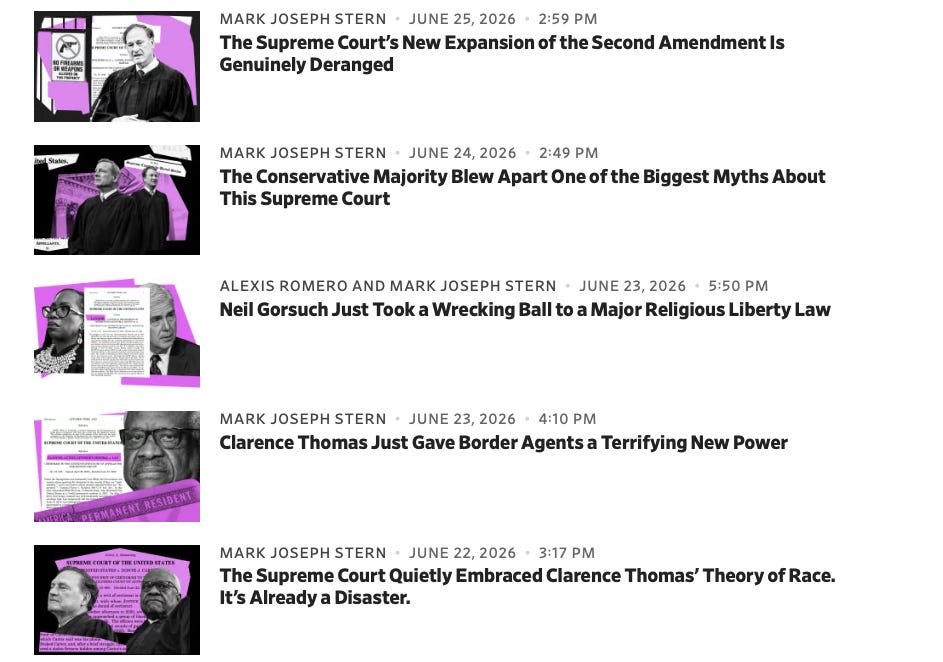
“Disaster.” “Terrifying.” “Wrecking ball.” “Blew apart.” “Deranged.” I know that some of this just comes down to the nature of headline-writing (and worth noting Stern himself doesn’t choose the headlines), but if everything the Roberts Court does is a disaster, then maybe we need to re-think what that word means.1
Birthright Citizenship got a lot of attention this term, but arguably the biggest case that was before the Court was Trump v. Slaughter, which concerned the President’s ability to fire (“remove”) the head of the Federal Trade Commission.
Because the FTC is an independent agency created by Congress, it was argued that Trump did not have the right to fire the had of the FTC, Rebecca Kelly Slaughter. Eventually, SCOTUS stepped in and said that he did, because if the President is really The President™, he has to be able to fire the people who work for him.
In doing so, the Court overturned the nearly 100-year-old precedent set by Humphreys Executor, an old SCOTUS case that prevented the president from firing agency heads. And here is my thing: Humphreys Executor is a bad decision. Why? Because a few years earlier, SCOTUS said in a decision called Myers that the president could fire agency heads. But when the (Republican) Court said that, a Republican was president.
When a Democrat got into office (FDR), SCOTUS went back on Myers and said he couldn’t remove the agency heads that were appointed by his predecessor. SIKE.
Humphreys Executor has/had maintained a Roe-like status in legal academia over the years, where everyone said they liked the outcome but conceded that the reasoning was poor. It was also transparently biased and a direct attack on FDR himself. It was after this decision that FDR threatened to pack SCOTUS, and then things started turning around for him.
The problem with overturning Humphreys is that now it gives Donald Trump the ability to remove the heads of agencies for any reason he wants. That is bad if you do not like Donald Trump, but it is good if you like President Jon Ossoff, who will not have to jump through hoops to fire his predecessor’s appointees in 2029. And it is hard to argue the Founders didn’t intend for it to work this way.2
During the Founding, lots of people were arguing against having an Executive branch altogether, on the basis that a powerful president would just be a king with a different title. Alexander Hamilton repeatedly argued against this idea, and said that a strong executive (with removal power) would ensure that the laws passed by Congress would actually have teeth. In practice, George Washington removed people without approval from Congress, and James Madison explicitly defended the president’s removal power in a speech to the House:
Another doctrine which has found very respectable friends, has been particularly advocated by the gentleman from South-Carolina (Mr. Smith). It is this; when an officer is appointed by the president and senate, he can only be displaced from malfeasance in his office by impeachment: I think this would give a stability to the executive department so far as it may be described by the heads of departments, which is more incompatible with the genius of republican government in general, and this constitution in particular, than any doctrine which has yet been proposed. The danger to liberty, the danger of mal-administration has not yet been found to lay so much in the facility of introducing improper persons into office, as in the difficulty of displacing those who are unworthy of the public trust. If it is said that an officer once appointed shall not be displaced without the formality required by impeachment, I shall be glad to know what security we have for the faithful administration of the government.
He later says, “But there is another part of the constitution which inclines in my judgment, to favor the construction I put upon it; the president is required to take care that the laws be faithfully executed. If the duty to see the laws faithfully executed be required at the hands of the executive magistrate, it would seem that it was generally intended he should have that species of power which is necessary to accomplish that end.”
It seems pretty clear that Trump’s ability to remove Slaughter falls well-within the bounds of what the Founders intended. And if Humphreys is a bad decision, it should be repudiated and overturned, even if the outcomes are bad.
My main gripe with a lot of the left-wing reaction to the Court is that guys like Stern are heavily focused on the bad outcomes coming out of SCOTUS decisions, rather than the decisions themselves.
There was a case this term called Landor v. Louisiana Department of Corrections. The details of the case are truly horrific: An inmate, Damon Landor, was transferred to a new prison, which had a policy that all inmates must keep their hair short. However, Landor is a practicing Rastafarian, and has a firm religious belief that he cannot cut his hair. He even had a note from a court saying as much. Despite this, Landor was forcibly restrained and the prison guards shaved his head. They even took the note he had and threw it out.
It’s truly disgusting behavior. Landor did seek out a remedy, and attempted to sue the prison guards under a Federal religious protection law. Basically, he argued that because Louisiana’s prisons receive Federal money, their employees should be liable for damages.
SCOTUS rejected Landor’s claims, which is heartbreaking on its face. And the left-wing reaction argued that SCOTUS was heartless and evil for failing to help Landor. What happened to Landor fills me with deep sadness, but the decision from SCOTUS was correct. Imagine this scenario: A mother and her son are driving on a highway, and a swarm of bats fly into their car through its open windows. The mom loses control of the car and goes off-road, crashing and knocking herself unconscious.
Paramedics show up, scare the bats off with pictures of Stephen Miller, and take both the mom and her son to the hospital. Because the son was bitten by a bat, the paramedics take emergency action and give the boy an anti-rabies vaccine. When the mother wakes up, she finds out what happens and is livid; her personal religion forbids the use of any vaccines on her children.
If SCOTUS had sided with Landor, the mother in this situation would have means to sue the doctors who administered the vaccine to her son. They (1) violated her religious rights, and (2) possibly caused lasting damage to her son (vaccines are safe but this is her belief we’re talking about). The doctors who were there all take some sort of money from the Federal government; does that mean they have implicitly agreed to all of its liability rules? Surely not. The majority was correct in their reasoning and I don’t see how there could have been a single dissent.
The Landor decision had a horrific outcome for Landor himself. But outcomes are not the only thing that SCOTUS looks at.
Whether it's Humphreys or Landor, the Court has to look at more than just the facts of each case that are in front of them, and sometimes that produces bad outcomes for the country. But it’s not SCOTUS’s job to save us from ourselves. By design, it is the least-democratic institution of the three branches of government because the justices have to make decisions on cases that are going to outlast them, whatever Administration they are serving under, and the Congress that confirms them.
This doesn’t mean that the Court always gets it right. I disagree with them a ton, and sometimes it’s with the entire decision itself (presidential immunity). Other times, I agree with the outcome and think the reasoning is bad (Trump being barred from Office and Heller). SCOTUS is also sometimes influenced by politics: The case upholding Obamacare should have been a 9-0 decision and Citizens United should have also been a 9-0 decision. Instead, both were partisan splits.
It is fine to have these disagreements with the Court, but it super damaging to it as an institution to always act like it is destroying the country. America has survived lots of bad SCOTUS decisions, like Plessy v. Ferguson, Dred Scott, and Korematsu.
These are all SCOTUS decisions that have been condemned by the Roberts Court, which is historically an unusual move from SCOTUS. Korematsu was repudiated for the very first time by Roberts himself.
It’s not a perfect institution by any means, but none of this is perfect. We are in Babylon. The Perfect is coming.
Until then, this is what we’ve got, and we have a pretty good thing going. I am worried about lots of things that are bubbling up on the Right, but I really do worry that the Left is going to take a wrecking ball to SCOTUS once they get power, and I don’t think anyone will like the results.
You got this because it’s been in my brain for a few weeks and because the term has been wrapped up for a while now. I’ll try to have some more stuff come out during the August recess but no promises.
This doesn’t really fit in the main body so it’s ending up as a footnote. The headline of one of Stern’s pieces above argues that SCOTUS “expanded” the Second Amendment, in reference to the recent SCOTUS decision striking down a law passed in Hawaii. In that case, SCOTUS said that Hawaii’s law - which, by default, bans all guns in private businesses - overstepped the Second Amendment’s protections.
Hawaii’s law means that if a registered gun owner with a concealed carry permit tries to go into a business with his/her gun, they are subject to a fine and penalty. That certainly seems like a violation of the Second Amendment.
Where I think the Left and Right knock into each other on the Second Amendment is that the Left is simply mad that the Amendment exists at all. Spoiler: I am not a pro-gun person! I do not own one and do not plan on buying one. I recognize that states with stricter gun regulations are safer and less violent than states with looser gun regulations.
But I also acknowledge that the Second Amendment exists and that if we want to make fundamental changes to many gun laws in this country, we should amend the Constitution. That is the way the system works!
Moreover, private businesses in Hawaii can still ban guns on their property. Like anywhere else, they can put a sign up that tells people to leave their guns at home. SCOTUS affirmed that in this decision; they just said a state cannot by default do a blanket restriction on all private property. But if every private business in Hawaii put up a sign that said, “No guns please,” literally nothing would change.
And only Hawaii and New York have these laws. It is a narrow decision on a minor issue, but the coverage of it has been so over-the-top.
You can say a lot of things about the Deep State™, and as a dyed-in-the-wool technocrat, I am partial to it. But it’s not especially democratic; if Americans can expect nothing to change when they elect a new executive every for years, then what is the point of an election at all? We deserve our democratic results, good and hard.